21 October 2026
Shoplifting: Need or Greed?
Infant formula theft in the UK cost-of-living crisis. A leaflet written for Assessment A (coursework) of FDY3008, Investigation and Innovation Project, on the LLB Law with Foundation Year (Hons) at Arden University. Submitted 21 October 2026, inside the deadline, at 542 words. Published here as submitted, with the cover sheet left off.
Introduction
Infant formula is a factory-made milk powder that replaces or adds to breast milk for babies under one year old. Rising prices left struggling families caught between the cost of formula and what they could pay. Shops of every size have tightened security to stop formula being stolen. Those who steal it seem to fall into two groups: those who need it, and those who steal it out of greed. The options are limited. Shoplifting can bring guilt, shame and remorse, but for some parents, leaving a baby hungry may feel just as wrong as taking without paying. Set against Target 2.1 (Zero Hunger) and Target 3.2 (Good Health and Well-being) of the UN Sustainable Development Goals, formula shoplifting paints a picture of policy gaps, which often translates into a response focused on preventing theft rather than on supporting those in need. With the cost-of-living crisis far from over, the question of need or greed has become more relevant, not less. This leaflet opens the ledger, weighing the data, the policies already in place, and the safety net meant to support those who need it most, following the chain in its precise order: price, gap, desperation, theft and law.1
Background and Context
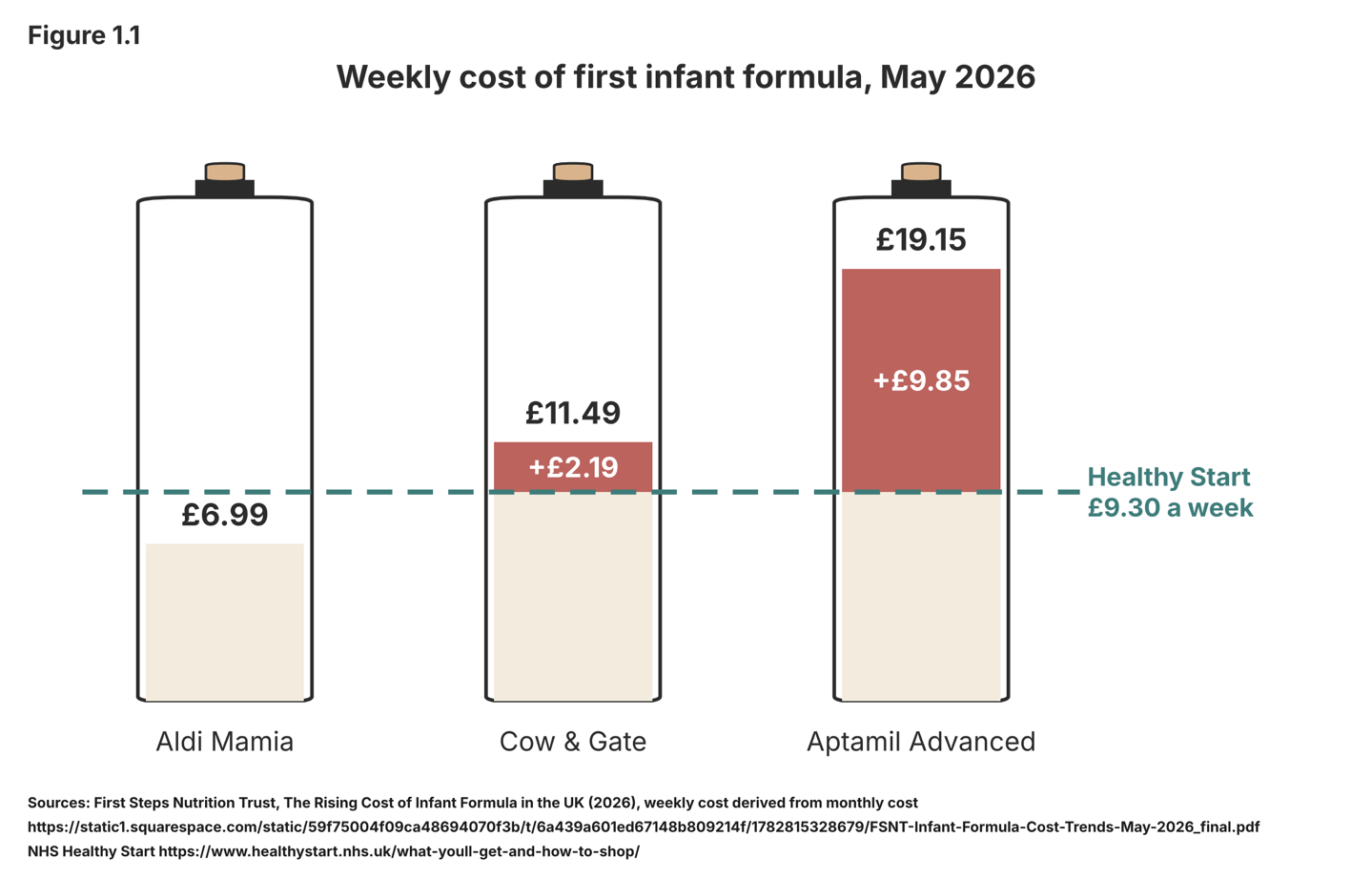
Formula prices reflect weak price competition, driven largely by branding. Manufacturers compete for publicity rather than on quality, because every first infant formula in the UK must meet the same legal nutritional standard. Figure 1.1 sets the weekly cost of three formulas against Healthy Start, the NHS allowance for low-income families: only the cheapest stays within it. A gap in parental knowledge can therefore cost up to £500 in a baby’s first year.2
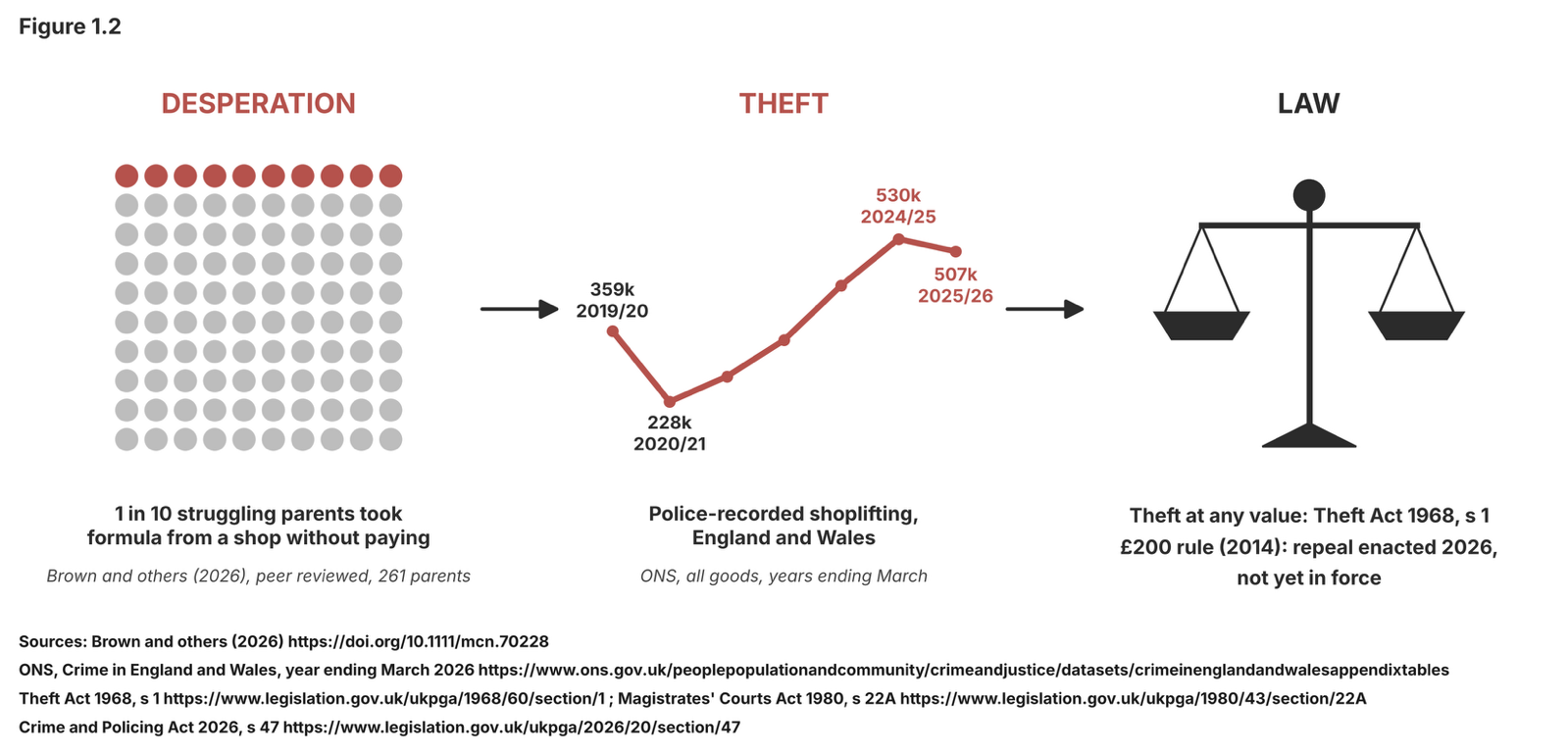
With Figure 1.2, the chain is complete. Desperation begins at home, among the vulnerable, and moves into the shop. Theft shows how formula began to disappear from shelves without payment, yet police records do not show how much, because formula is not recorded separately from other shoplifting. Finally, the law: since 2014, theft of goods worth £200 or less has normally been tried in the magistrates’ courts, a rule whose repeal was enacted in 2026 but not yet in force. There, sentencing guidelines must weigh the letter of the law against what Lord Morris and Lord Diplock, in a different context, called “common humanity”. Their words name the very tension a desperate parent brings before the court.3, 4
From shops facing losses to embarrassed parents, police, judges and policymakers, the cost-of-living crisis reshapes how shoplifting is seen. Each faces a hard choice. The law keeps a community whole and morality gives it shape, yet the same law that refused hunger as an excuse for theft must now heed common humanity: the tacit duty to secure the survival of the infant.5
Notes
- United Nations, ‘Goal 2: End hunger, achieve food security and improved nutrition and promote sustainable agriculture’ https://sdgs.un.org/goals/goal2 accessed 20 October 2026; United Nations, ‘Goal 3: Ensure healthy lives and promote well-being for all at all ages’ https://sdgs.un.org/goals/goal3 accessed 20 October 2026.
- Competition and Markets Authority, Infant Formula and Follow-on Formula Market Study: Final Report (14 February 2025) https://www.gov.uk/government/publications/infant-formula-and-follow-on-formula-market-study-final-report accessed 21 October 2026; Commission Delegated Regulation (EU) 2016/127 of 25 September 2015 supplementing Regulation (EU) No 609/2013 as regards the specific compositional and information requirements for infant formula and follow-on formula [2016] OJ L25/1.
- Amy Brown and others, ‘Infant Formula Affordability Negatively Impacts Parental Wellbeing, Financial Security and Safe Feeding Practices in the UK’ (2026) 22(3) Maternal and Child Nutrition e70228.
- British Railways Board v Herrington [1972] AC 877 (HL).
- Southwark London Borough Council v Williams [1971] Ch 734 (CA).
Bibliography
Cases
British Railways Board v Herrington [1972] AC 877 (HL) Southwark London Borough Council v Williams [1971] Ch 734 (CA)
Legislation
Anti-social Behaviour, Crime and Policing Act 2014 Crime and Policing Act 2026 Magistrates’ Courts Act 1980 Theft Act 1968 Commission Delegated Regulation (EU) 2016/127 of 25 September 2015 supplementing Regulation (EU) No 609/2013 as regards the specific compositional and information requirements for infant formula and follow-on formula [2016] OJ L25/1
Secondary sources
Brown A and others, ‘Infant Formula Affordability Negatively Impacts Parental Wellbeing, Financial Security and Safe Feeding Practices in the UK’ (2026) 22(3) Maternal and Child Nutrition e70228 Competition and Markets Authority, Infant Formula and Follow-on Formula Market Study: Final Report (14 February 2025) https://www.gov.uk/government/publications/infant-formula-and-follow-on-formula-market-study-final-report accessed 21 October 2026 First Steps Nutrition Trust, The Rising Cost of Infant Formula in the UK: March 2021 to May 2026 (2026) https://static1.squarespace.com/static/59f75004f09ca48694070f3b/t/6a439a601ed67148b809214f/1782815328679/FSNT-Infant-Formula-Cost-Trends-May-2026_final.pdf accessed 21 October 2026 NHS Healthy Start, ‘What You’ll Get and How to Shop’ https://www.healthystart.nhs.uk/what-youll-get-and-how-to-shop/ accessed 21 October 2026 Office for National Statistics, ‘Crime in England and Wales: Appendix Tables, Year Ending March 2026’ https://www.ons.gov.uk/peoplepopulationandcommunity/crimeandjustice/datasets/crimeinenglandandwalesappendixtables accessed 21 October 2026 United Nations, ‘Goal 2: End Hunger, Achieve Food Security and Improved Nutrition and Promote Sustainable Agriculture’ https://sdgs.un.org/goals/goal2 accessed 20 October 2026 United Nations, ‘Goal 3: Ensure Healthy Lives and Promote Well-being for All at All Ages’ https://sdgs.un.org/goals/goal3 accessed 20 October 2026